 Add to Chrome
 Add to Firefox
 Add to Edge
Tackling the Root of Misinformation by Teaching Laypeople about Logical Fallacies via Socratic Questioning and Critical Argumentation
May 31, 2026
Identifying logical fallacies in everyday discourse is challenging for many people. This challenge is amplified in the era of Large Language Models (LLMs), where malicious agents can deploy fallacious arguments to disseminate misinformation at scale. In this work, we explore the potential of LLMs as part of the solution. We introduce LFTutor, an intelligent tutoring system which uses LLMs to tutor laypeople and help them learn about logical fallacies. LFTutor integrates intent-driven Socratic questioning and critical argumentation principles to actively engage learners to reflect on their reasoning. Through both automatic and human evaluations, we demonstrate that LFTutor significantly outperforms baseline LLMs lacking these pedagogical strategies. This work highlights the promise of combining LLMs with pedagogical scaffolding to foster critical thinking and argument literacy in the age of AI.
* This paper has been accepted to Proceedings of the 64th Annual Meeting of the Association for Computational Linguistics (Long Paper), Main Conference

Logit Distillation on Manifolds: Mapping by Learning
May 30, 2026A simple way to improve the performance of almost any machine learning model is not to train a single but several models with diverse algorithms which will make slightly distinct kinds of predictions and errors on the same data, and thus improve the average predictions and robustness. However, making predictions using a whole ensemble of models is cumbersome and computationally too expensive to allow deployment to a large number of users, especially if the models are large neural nets. In response to this, we introduce a layer and point wise projection mapping, which maps student and teacher representations into an aligned high-dimensional embedding space during training process. The proposed approach combined with LoRA injection reduces the student model trainable parameters to less than 1% of the teacher model, while significantly improving word error rate (WER) compared to other distillation methods, as demonstrated in ablation studies. Unlike a mixture of experts, our method can be trained rapidly and in parallel.
Benchmarking and Enhancing Text-to-Image Models for Generating Visual Representations in Early Arithmetic Education
May 29, 2026AI systems are increasingly used to support educational content creation, yet it remains unclear whether they can generate outputs that faithfully represent the pedagogical concepts they are intended to teach. Thus, we introduce equation-to-visual generation, a task that, in contrast to conventional image generation, requires producing pedagogically meaningful visuals from arithmetic equations while precisely preserving their numerical and relational structure. Informed by interviews with teachers and an analysis of educational materials, we construct E2V-Bench, a benchmark spanning four pedagogically grounded visual types, along with automatic metrics for evaluating visual correctness. Our evaluation reveals that recent text-to-image (T2I) models frequently fail on this task, with errors dominated by incorrect object counts and broken relational structure. Building on this, we explore benchmark-guided enhancement strategies. These strategies improve representative models, while the remaining gap calls for stronger numerical and relational grounding in future T2I models.
Unveiling the Visual Counting Bottleneck in Vision-Language Models
May 28, 2026While Large Vision-Language Models (VLMs) excel at interpolation, they suffer catastrophic failures in systematic generalization, most notably in visual counting. In this work, we investigate this extrapolation bottleneck by deconstructing visual counting into three cognitive stages: visual individuation, magnitude awareness, and symbolic mapping. Using synthetic Go boards and linear probes, we demonstrate that visual backbones maintain robust, linearly separable representations of quantity well into the extrapolation regime, ruling out perceptual failure. Furthermore, models retain latent magnitude awareness, successfully performing comparative reasoning on quantities they fail to enumerate. We pinpoint the collapse to the symbolic mapping stage, where the model fails to project valid visual magnitudes onto symbolic tokens. Our findings support a frac tured magnitude hypothesis: VLMs fail to acquire a universal number space, instead learning disjoint, modality-specific statistical manifolds that prevent cross-modal grounding for unseen quantities. Validated on the state-of-the-art foundation model, our results suggest that bridging this gap requires inductive priors enforcing unified representations, as data scaling alone is insufficient.
Two-Point Resolution in Spectral Super-Resolution
May 06, 2026Two-point super-resolution is an important problem in many signal processing applications. In this paper, we aim to establish a resolution theory for two-point super-resolution from a single snapshot. We consider a complex two-point model with unequal amplitudes and a nontrivial relative phase, and derive super-resolution upper bounds (SRUs) guaranteeing resolvability as well as super-resolution lower bounds (SRLs) below which stable reconstruction is impossible. The resulting bounds provide an explicit characterization of how the amplitude ratio and, more importantly, the relative phase affect the resolution limit for both source-number detection and location estimation. In the in-phase regime, the classical resolution exponents are retained: \((σ/m)^{1/2}\) for source-number detection and \((σ/m)^{1/3}\) for location estimation. In the out-of-phase regimes, the phase term significantly changes the resolution limit: it acts as a direct subtractive term in the near-endpoint regime, and improves the scaling orders in the large-phase regime to \(σ/m\) for source-number detection and \((σ/m)^{1/2}\) for location estimation. Extensive numerical experiments across different phase regimes and reconstruction algorithms validate the predicted scaling laws and theoretical resolution boundaries. Moreover, comparison with our resolution limit in all phase regimes reveals the optimality of \(\ell_0\), ML, and ESPRIT algorithms, and the non-optimality of SVT, MUSIC, and the convex method, a finding that, to the best of our knowledge, has not been reported before. Collectively, our results show that the phase of amplitudes is not merely a nuisance in super-resolution, but a key factor that can be exploited to improve stable resolvability.
SPARC: Separating Perception And Reasoning Circuits for Test-time Scaling of VLMs
Feb 06, 2026Despite recent successes, test-time scaling - i.e., dynamically expanding the token budget during inference as needed - remains brittle for vision-language models (VLMs): unstructured chains-of-thought about images entangle perception and reasoning, leading to long, disorganized contexts where small perceptual mistakes may cascade into completely wrong answers. Moreover, expensive reinforcement learning with hand-crafted rewards is required to achieve good performance. Here, we introduce SPARC (Separating Perception And Reasoning Circuits), a modular framework that explicitly decouples visual perception from reasoning. Inspired by sequential sensory-to-cognitive processing in the brain, SPARC implements a two-stage pipeline where the model first performs explicit visual search to localize question-relevant regions, then conditions its reasoning on those regions to produce the final answer. This separation enables independent test-time scaling with asymmetric compute allocation (e.g., prioritizing perceptual processing under distribution shift), supports selective optimization (e.g., improving the perceptual stage alone when it is the bottleneck for end-to-end performance), and accommodates compressed contexts by running global search at lower image resolutions and allocating high-resolution processing only to selected regions, thereby reducing total visual tokens count and compute. Across challenging visual reasoning benchmarks, SPARC outperforms monolithic baselines and strong visual-grounding approaches. For instance, SPARC improves the accuracy of Qwen3VL-4B on the $V^*$ VQA benchmark by 6.7 percentage points, and it surpasses "thinking with images" by 4.6 points on a challenging OOD task despite requiring a 200$\times$ lower token budget.
Can Vision-Language Models Solve Visual Math Equations?
Sep 10, 2025Despite strong performance in visual understanding and language-based reasoning, Vision-Language Models (VLMs) struggle with tasks requiring integrated perception and symbolic computation. We study this limitation through visual equation solving, where mathematical equations are embedded in images, variables are represented by object icons, and coefficients must be inferred by counting. While VLMs perform well on textual equations, they fail on visually grounded counterparts. To understand this gap, we decompose the task into coefficient counting and variable recognition, and find that counting is the primary bottleneck, even when recognition is accurate. We also observe that composing recognition and reasoning introduces additional errors, highlighting challenges in multi-step visual reasoning. Finally, as equation complexity increases, symbolic reasoning itself becomes a limiting factor. These findings reveal key weaknesses in current VLMs and point toward future improvements in visually grounded mathematical reasoning.
* Monjoy Narayan Choudhury and Junling Wang contributed equally to this work. Accepted at EMNLP2025 main. Code and datasets are open-sourced with links in the paper
Book2Dial: Generating Teacher-Student Interactions from Textbooks for Cost-Effective Development of Educational Chatbots
Mar 05, 2024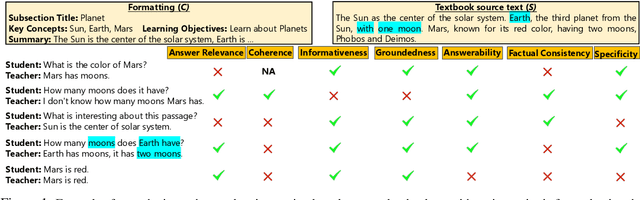
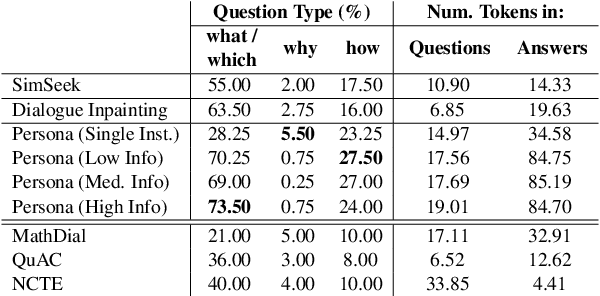
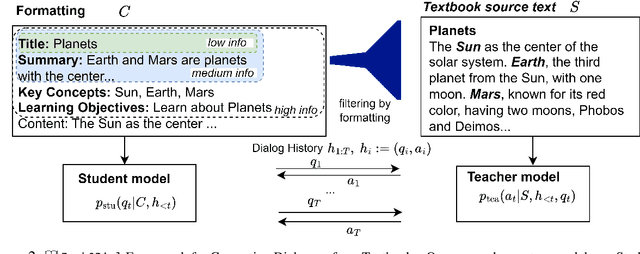
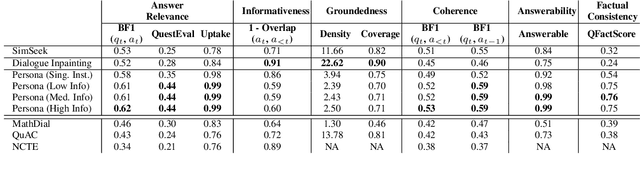
Educational chatbots are a promising tool for assisting student learning. However, the development of effective chatbots in education has been challenging, as high-quality data is seldom available in this domain. In this paper, we propose a framework for generating synthetic teacher-student interactions grounded in a set of textbooks. Our approaches capture one aspect of learning interactions where curious students with partial knowledge interactively ask a teacher questions about the material in the textbook. We highlight various quality criteria that such dialogues should fulfill and compare several approaches relying on either prompting or fine-tuning large language models. We use synthetic dialogues to train educational chatbots and show benefits of further fine-tuning in different educational domains. However, human evaluation shows that our best data synthesis method still suffers from hallucinations and tends to reiterate information from previous conversations. Our findings offer insights for future efforts in synthesizing conversational data that strikes a balance between size and quality. We will open-source our data and code.